
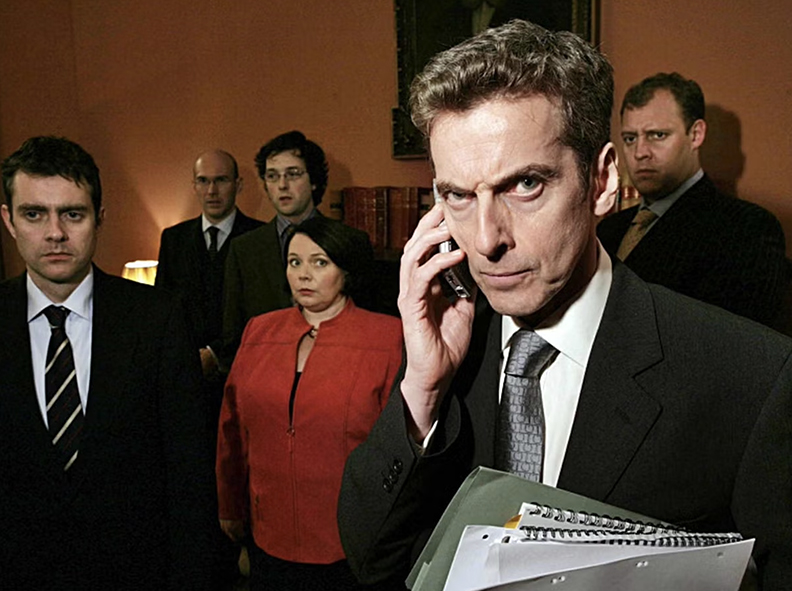
Should you doubt the distorting influence of The Thick of It in British political culture, consider the word “febrile”. Rich in linguistic provenance, and straightforwardly fun to say, it arrived to us almost intact from the Medieval Latin for “fever”, and meant basically the same thing. Though I can’t see it got much exercise – I know doctors used to be posher than they are now, but I can’t imagine anyone tossing “febrile” around an A&E ward on a Saturday night.
That all changed on 28 November 2009, when this dishonoured little mot had the misfortune to appear in dialogues of Malcolm Tucker. “The situation’s fucking febrile.” Now the Westminster equivalent of some two-bit soapstar, doubling appearances in Doctors and The Bill, it appears several times a week, everywhere from petit-bourgeois broadsheets to commentary columns to newsletter round-robins. Start looking, and you’ll see it everywhere.
This ubiquity is ironic on multiple levels. In the original episode, when Malcolm Tucker says “The situation’s fucking febrile,” and adds, “You don’t know what fucking ‘febrile’ means do you?”, he then explains: “It means there are gonna be hysterical journalists, right, watching every fucking move we make.” Apparently the Westminster viewership took this not as a joke but a gloss. You almost feel that it’s the correction, and the implied statement of superiority, that has made it stick. Every time some pudgy hack squashes his “F” key to begin his latest “febrile”, he seems to truly believe that it means something like “bad”, or “busy”, or, at its most complex, “hot and bothered”. (“It’s very febrile out there this afternoon,” one journalist tweeted yesterday, having seen an “incredibly febrile” night on 11 May, and “another febrile 24 hours” on the 10th – approaching 72 hours of sweaty febrility.)
“Febrile” is the noblest victim in a massacre. Because a staggering amount of the language around Westminster – fair and foul – descends from this programme. In fact we can even register something of a decline in usage. One senior Cabinet minister reportedly commented during the denouement of Theresa May, “Fuck knows, I’m past caring, it’s like The Living Dead in here,” which is pretty funny; “It’s f***ing f***ed,” one senior Labour source reportedly commented last week, following the local elections, which is really crap.

The desired tone is ostentatiously filthy and casually referential, in a knowing, pop-cultural sense. Visit any SW1 pub any hot Tuesday and you’ll find a dozen boys, half-cut and goggling, and talking like this, or at least trying to. You will also, during moments of political crisis like this, find social media ablaze with Malcolm Tucker invective, resuscitated in clips and gifs. “The Thick of It scene for everything once again,” as one X user commented yesterday.
Whatever else is said, the writing in The Thick of It is one of the great achievements of 21st-century British television. But as viewers have idealised and then imitated its style, it’s been forgotten that the manners of its characters have a structural as well as an aesthetic function, part of the series’ argument about how British government worked in the mid-Noughties. First airing in 2005, The Thick of It was one of first commentaries upon the way that power had changed in Britain.
This argument found prose form in Peter Oborne’s books The Rise of Political Lying and The Triumph of the Political Class. And it was as much sociological as political: under New Labour, a non-ideological class of Spads, spinners, spear-chukkas, and bag-carriers had coagulated in the vessels of politics. Reflective of the relative ideological stability of the time, when the only contest was over which of the two available major talents should lead the Labour Party, these figures became obsessed by the management of power, settling for attracting small percentages of voters via technique rather than genuine appeal. The Thick of It satirised the inhabitants of this political asteroid belt, coldly circling the solar system of power. It is forever remarked how accurate this depiction was, and is, and it was produced with advice from real Blair-era advisers.
The Thick of It finished in 2012, with a widely celebrated final speech from Tucker on the darkness of politics, as a legal inquiry begins to expose him and his colleagues. Tucker is arrested on charges of perjury, and the episode was broadcast five months after Andy Coulson, a typical spin doctor of the era, was charged with the same crime. Very quickly though, from roughly the beginning of the Ukip surge in 2013 and accelerating with the 2014 Scottish independence referendum, politics ceased to be about such shadowy figures, or at least came to be less about them. It was in this period also that “technocracy” became a pejorative. Indeed, the populist quake of the 2010s is sometimes labelled “anti-politics”, and took direct aim against the “dark arts”, making villains of the men like Alastair Campbell and Peter Mandelson who practised them.
The longevity of both men in public life prove that these figures and their methods still have some cachet among the continuity political class. But Mandelson, along with the other New Labour figures who re-entered government under Keir Starmer, has since been ejected. The weather is made by those politicians who become the spokesmen for real, self-righteous and intensely moral movements around Gaza, immigration, nationalism, and inequality. For all that politics feels unstable, this almost feels like an improvement.
Meanwhile, among journalists and presumably inside No 10, Westminster’s favourite TV continues to supply the script. Even Beth Rigby faffing over her microphone rig has become another scene. There is a type of Westminster satellite for whom, life not otherwise diverted or adorned, politics must become a consuming drama. You can see why they’d rather do politics in the Borgian manner: feuds, apercus and fuck yous.
There will always be harried advisers and incompetent civil servants in Whitehall, and they will always remind us of The Thick of It. There will also always be boys who find swearing funny. But using the programme as an analogue for own crises is a reflex of nostalgia, an attempt to confine our events back into a world where motivations are predictable because amorality is guaranteed. Political failure can’t be explained away by “omnishambles” speeches, “marzipan dildo” ministers or “clusterfuck” interviews anymore. And the country isn’t “febrile”, but deeply, angrily, ill.
[Further reading: Patrick Radden Keefe’s obituary for Britain]
Content from our partners



Related

Join the debate
Subscribe here to commentLife febrilely imitating art.
Another obscure medical expression which could enjoy a vibrant second life in politics is constitutional disease.